 English ✓
 Deutsch
 Français
 Español
 Italiano
 Magyar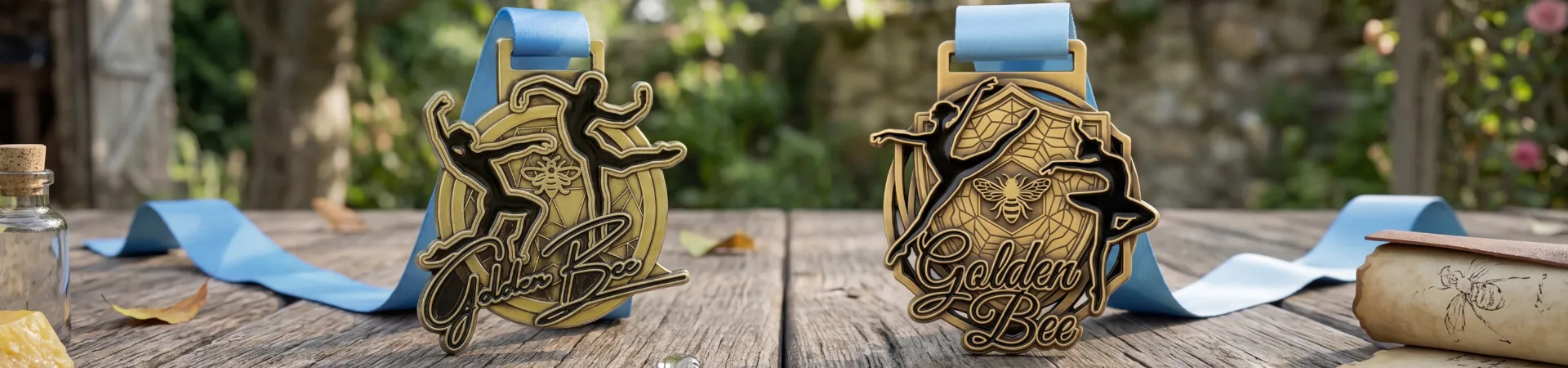
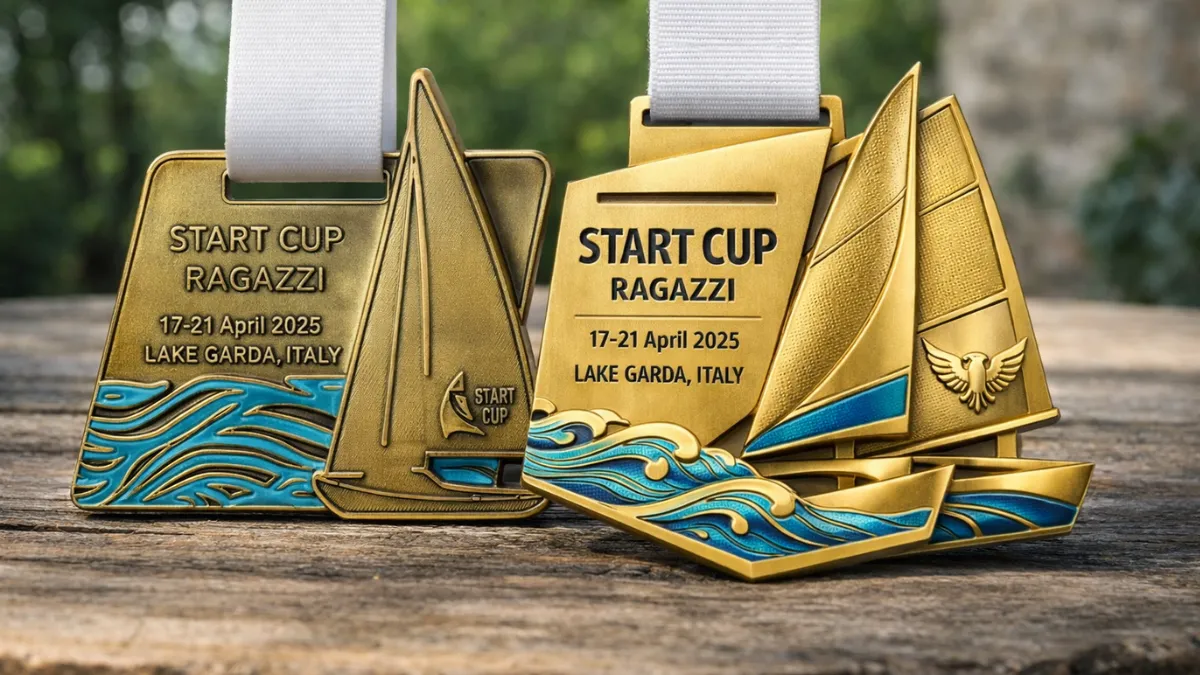
AI design tools have changed the way event organisers think about custom awards. You type a few sentences, hit generate, and within seconds you're looking at a striking medal visualisation. The problem? Most of those designs are impossible to manufacture.
In this guide, you will learn how to write prompts that do not just produce beautiful images — they give designers and manufacturers something they can genuinely work with. You will save time, avoid costly back-and-forth, and end up with a custom medal your participants will actually want to keep.
Why AI Regularly Designs Medals That Cannot Be Made
Generative tools such as Midjourney, DALL·E, and Stable Diffusion are trained on billions of images. Their goal is to produce something visually compelling — not to verify whether an engraving workshop can reproduce a detail at 0.2 mm depth.
The result is artwork that looks spectacular on screen but routinely contains:
- Bridges between elements that are too thin — they will simply break during zinc or brass casting
- Gradients and photographic shading — impossible to reproduce via die-stamping
- Text smaller than 2.5 mm — illegible after casting, even with laser engraving
- Undercuts and negative angles — die-casting requires draft angles that allow the medal to release cleanly from the mould
- Photorealistic surface textures — beautiful in a render, unachievable in metal without extraordinary hand-finishing costs
This does not mean AI is useless for medal design. It means you need to learn to speak to it in a language a manufacturer understands.
Before You Open Any AI Tool — Define Your Production Constraints
The most effective prompt starts not with a creative idea but with a set of technical boundaries. The more of these you build in, the more realistic the output.
Key Production Parameters to Know Before You Prompt
| Parameter | Typical Values | Impact on Design |
|---|---|---|
| Diameter / size | 50–any mm (70 mm most common) | Sets the scale of details and text |
| Metal thickness | 2–8 mm | Thinner stock = shallower relief |
| Relief depth | 0.3–1.5 mm | Shallow = fine lines; deep = bold sculpture |
| Minimum line width | ≥ 0.8 mm | Finer lines will not survive casting |
| Minimum text height | ≥ 2 mm (3 mm+ preferred) | Below this, lettering becomes illegible |
| Material | Zamak, steel, plywood | Each handles fine detail differently |
| Finish | Gold, silver, antique, enamel fill | Affects how much detail reads clearly |
Write these values down before you prompt. They form the foundation of everything that follows.
Building an Effective Prompt — The Six-Layer Structure Most People Miss
A typical prompt looks like this:
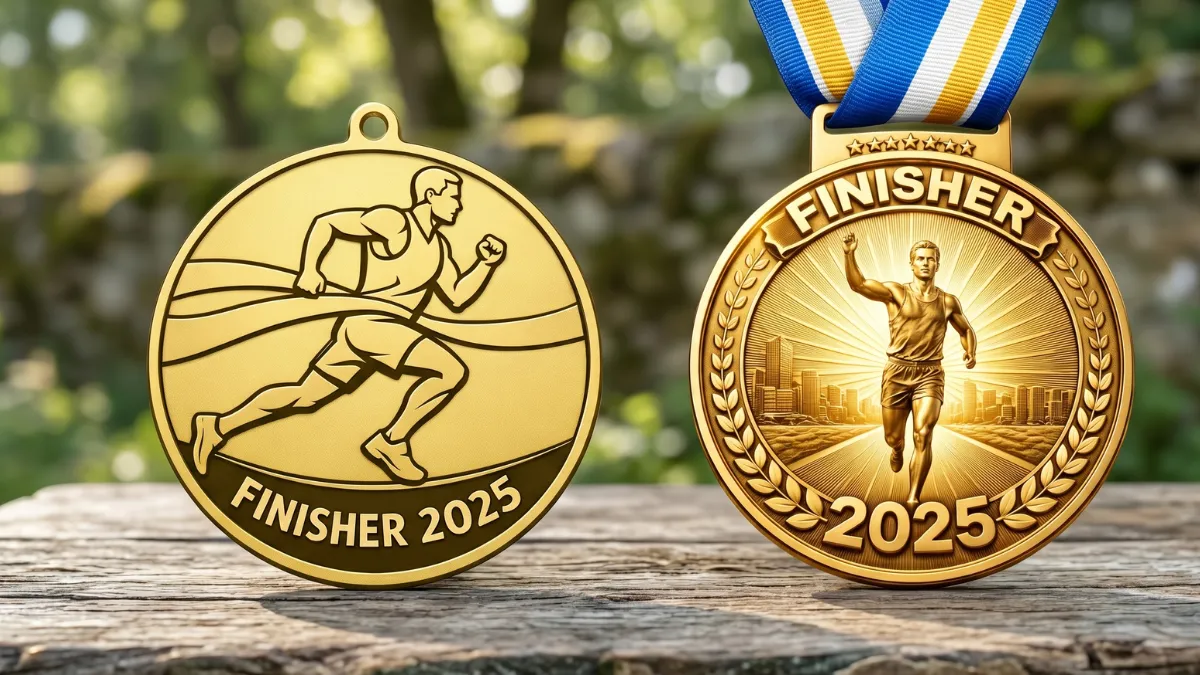
"A gold marathon finisher medal with a runner and the text 'Finisher 2025'"
That is not enough. AI will treat it as a graphic design exercise and produce something beautiful and unbuildable. An effective prompt needs six distinct layers.
Physical Context
Tell the AI what a medal actually is as a physical object — its diameter, thickness, material, and finish. Without this, it will treat your request as a flat graphic design brief.
Production Constraints
Build the manufacturing rules directly into the prompt. Specify minimum line widths, text height limits, and explicitly forbid gradients or photographic shading — raised and recessed flat surfaces only.
Subject Matter and Symbolism
Now add your creative content: the central figure, any background elements, and all text — including its placement (e.g. arched along the lower edge).
Style and Character
Describe the aesthetic: contemporary, classical, minimalist, bold. Name a reference style if you have one — for example, "modern Olympic medal aesthetic" or "art deco relief".
Technical View (Optional but Highly Effective)
Ask for a flat top-down view with no perspective distortion and no lighting effects. It should read like a technical drawing, not a 3D render — making it far easier for a manufacturer to evaluate.
Explicit Exclusions
End every prompt with a list of what to avoid: no photographic shading, no gradients, no elements thinner than 1 mm, no photorealistic textures. AI responds well to explicit negatives.
Here is what all six layers look like combined into a single, complete prompt:
Design a metal medal 70 mm in diameter and 5 mm thick, produced via zinc die-casting with a gold-plated finish.

All lines must be at least 1 mm thick. No text smaller than 3 mm in height. No gradients or photographic shading — raised and recessed flat surfaces only.

Subject: a runner in full stride, viewed from the side. High relief, dynamic pose. A finish-line tape in the background. The text 'FINISHER 2025' arched along the lower edge.

Style: contemporary and minimalist. Strong contrast between raised and recessed areas. Reference: modern Olympic medal aesthetic.

Show the design as a flat top-down view with no perspective distortion and no lighting effects.

No photographic shading. No gradients. No elements thinner than 1 mm. No photorealistic textures.
A complete prompt combining all six layers will run to five or eight sentences. In return, you will receive a concept that a manufacturer can actually evaluate.
Reviewing the Output — How to Tell "Beautiful" from "Buildable"
Once you have your generated design, run through this checklist before sending anything to a manufacturer.
- Do all graphic elements have clean, defined edges — no blur or feathering?
- Is the design built from raised and recessed flat surfaces only — no gradients?
- Is every decorative element at least approximately 1 mm thick at production scale?
- Is all text legible and appropriately sized?
- Are there any "islands" — elements that float disconnected from the rest of the design?
- Does the background read clearly — either solid metal or a distinctly textured field?
If the answer to any question is "no", return to your prompt and refine it before moving on.
What a Manufacturer Does With an AI-Generated Design
An AI concept is an excellent starting point — it is not a production-ready file. At Winmed, we accept AI designs as creative briefs and translate them into files ready for tooling and casting.
- Manufacturability — whether the shape can be released cleanly from a die
- Detail resolution — what will survive in zinc or brass, and what needs adjustment
- Text legibility after casting at the specified size
- Finish compatibility — galvanic gold plating reads detail differently from antique oxidising
We produce bespoke medals from 50 units, with lead times from three weeks. If you have an AI design you would like assessed, send it to us alongside your target specifications and we will respond within 24 hours.
FAQ
Can I send an AI-generated image directly to a manufacturer?
Not as a final file. An image from an AI tool (PNG or JPG) is a raster graphic with no vector data and no relief depth information. A manufacturer needs a vector file (AI, EPS, or SVG) or a 3D file (STL or OBJ). Treat the AI output as a visual brief, not a production asset.
Which AI tools work best for medal design concepts?
Midjourney and DALL·E 3 are effective for initial visualisation. For vector-based work, Adobe Firefly and Canva AI offer more controllable outputs. However, none of them replaces a technical review by an experienced manufacturer.
How much revision does a typical AI concept need before it can be produced?
With a well-structured prompt, usually one to three rounds of refinement with a designer. Without a considered prompt, you may face five or more revision cycles and significantly longer lead times.
Can AI design a medal that incorporates our company logo?
Yes — but the logo must be supplied separately as a vector file. AI can incorporate it conceptually into the design, but the final production file always requires original source artwork.
Does an AI-generated design have copyright protection?
This varies by jurisdiction and tool. In the UK and EU, purely generative outputs without meaningful human creative input are generally not protected by copyright. Check the terms of service of the tool you use, and seek legal advice if you intend to register or commercially license the design.
The Bottom Line
AI is a powerful ally in the medal design process — provided you treat it as a creative assistant, not a manufacturer. The single biggest factor separating a usable concept from an unusable one is the quality of your prompt. Specify diameter, minimum line widths, the absence of gradients, and your preferred relief style before you generate anything.
A finished concept is only the beginning. The next step is a manufacturability check with a producer who understands the difference between what looks striking on screen and what will come cleanly out of a casting die.
Send us your AI concept for a free technical review — we will tell you exactly what is achievable and at what price point, with a response guaranteed within 24 hours.
Get a Free Technical Review of Your AI Design
Send us your AI-generated concept. Our team will assess it for manufacturability and come back with a clear picture of what's achievable — within 24 hours, no commitment required.
SEND YOUR CONCEPT →Free review at: winmedal.eu/quotation